What Is a Battery?
An electric battery consists of one or more electrochemical cells that convert stored chemical energy into electrical energy. Batteries can be broadly classified according to their chemistry, construction, and whether they are designed for primary or secondary use.
Primary batteries are generally designed for non-rechargeable applications, while secondary batteries can be recharged after discharge. Common rechargeable battery technologies include lead-acid, nickel-metal hydride, and lithium-ion batteries.
Source: Wikipedia, Electric battery — Wikipedia – Electric battery
Battery Types and Their Applications
Battery technologies differ considerably in chemistry and application. Examples include alkaline batteries, lead-acid batteries, nickel-metal hydride batteries, lithium-ion batteries, lithium iron phosphate batteries, and other rechargeable technologies.
Battery applications include consumer batteries, automotive batteries, backup batteries, battery packs, electric-vehicle batteries, and battery-storage systems.
For a labeling-machine manufacturer, the battery chemistry itself is not always the main factor determining the labeling mechanism. The physical shape, dimensions, surface, label position, and production requirements are often more important when designing the labeling system.
Source: Wikipedia, List of battery types — Wikipedia – List of battery types
Battery Shapes and Their Impact on Labeling
Battery geometry is one of the most important factors when selecting a battery labeling machine.
Battery nomenclature systems distinguish different battery formats using shape and dimensional classifications. For example, cylindrical or round cells and prismatic cells have different physical configurations.
From a labeling perspective, these differences directly affect product positioning, label application, and the type of labeling mechanism required.
Source: Wikipedia, Battery nomenclature — Wikipedia – Battery nomenclature
圆柱形电池标签
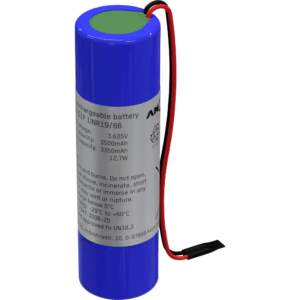
Cylindrical batteries have a round outer surface. This geometry means that a conventional flat-surface labeling mechanism may not be suitable when the label needs to cover part or all of the circumference.
For these applications, a wrap-around labeling system can rotate the battery while dispensing and pressing the label onto the curved surface.
A typical process is:
Battery Feeding → Product Detection → Positioning → Rotation → Label Dispensing → Wrap-Around Application → Pressing
The exact configuration depends on the battery diameter, label length, label material, required speed, and desired label position.
Source: Wikipedia, Battery nomenclature — Wikipedia – Battery nomenclature
棱柱形电池标签
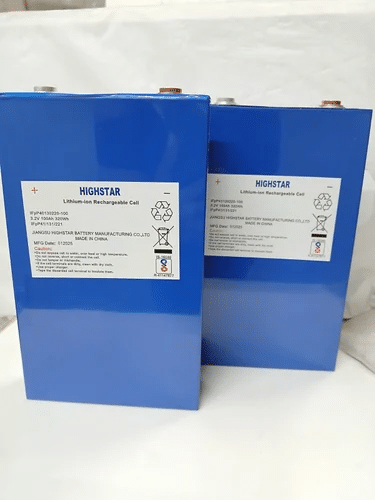
Prismatic batteries have a generally rectangular or box-like form factor. Their relatively flat surfaces can make them suitable for front, side, or top labeling.
A battery labeling machine for prismatic products may use side guides, conveyor belts, pneumatic clamps, or customized fixtures to maintain the correct product position during labeling.
The machine configuration should be determined from the actual battery dimensions and label position rather than simply the battery category.
Source: Wikipedia, Battery nomenclature — Wikipedia – Battery nomenclature
Lithium-Ion Battery Labeling
Lithium-ion batteries are widely used in portable electronics, electric vehicles, energy storage, and other applications.
A lithium-ion cell typically contains positive and negative electrodes, an electrolyte, and other components that allow lithium ions to move between the electrodes during charging and discharging. Commercial lithium-ion cells use different electrode materials and chemistries, including lithium iron phosphate and lithium nickel manganese cobalt oxide systems.
From a labeling-machine perspective, however, the most important characteristics are normally the battery’s physical dimensions, surface material, shape, label position, and production requirements.
Source: Wikipedia, Lithium-ion battery — Wikipedia – Lithium-ion battery
What Is a Battery Label?
A label is a piece of information-bearing material attached to a product or object. Labels can be attached using different technologies, including pressure-sensitive adhesives, heat-activated adhesives, wet glue, mechanical attachment, and other methods.
Pressure-sensitive adhesive labels are particularly common in industrial labeling because the adhesive forms a bond when pressure is applied to the surface.
For battery applications, the choice of label and adhesive should take into account the battery surface, operating temperature, cleanliness, required durability, and service environment.
Source: Wikipedia, Label — Wikipedia – Label
Source: Wikipedia, Pressure-sensitive adhesive — Wikipedia – Pressure-sensitive adhesive
What Information Can Battery Labels Contain?
Battery labels can be used to communicate product identification and technical information. Depending on the product and market, information may include:
Manufacturer or brand
Battery model
Voltage
Capacity
Polarity
Production information
Serial number
条形码
二维码
Safety information
Recycling information
The exact information required depends on the battery type, application, and applicable regulations in the target market.
Source: Wikipedia, Electric battery — Wikipedia – Electric battery
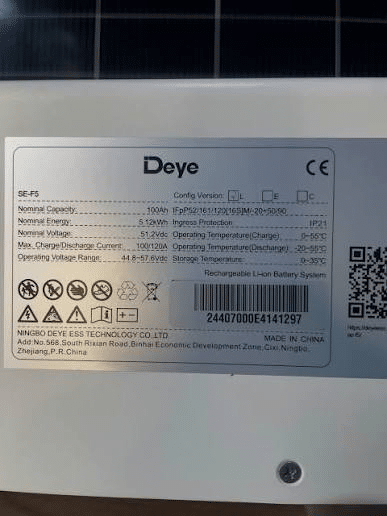
蓄电池贴标机
A storage battery labeling machine is designed for larger batteries used in energy storage, backup power, automotive, and industrial applications.
Compared with small consumer batteries, storage batteries may have substantially greater dimensions and weight. This means the labeling system may require heavy-duty conveyors, stronger product positioning mechanisms, and customized fixtures.
A typical process can include:
Battery Infeed → Positioning → Label Dispensing → Label Application → Pressing → Inspection → Outfeed
The machine should be designed around the actual battery weight and dimensions rather than using a standard conveyor without testing.
Portable Power Bank Labeling Machine
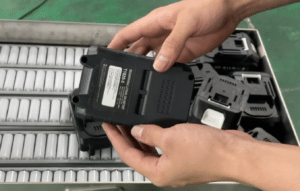
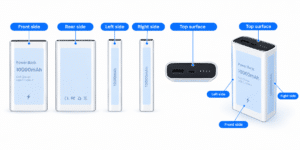
Portable power banks have a compact rectangular housing and are commonly labeled on the front, back, or side surface. A portable power bank labeling machine can automatically apply product labels, brand labels, technical information, barcodes, or QR codes with consistent positioning.
For high-volume production, the labeling system can be equipped with automatic feeding, product positioning, servo-controlled labeling, pressing, and vision inspection. Multiple power bank models can also be supported through adjustable mechanisms or recipe-based changeover.
Source: Wikipedia, Power bank — General information about portable battery chargers and power banks. Wikipedia – Power bank
How Does a Battery Labeling Machine Work?
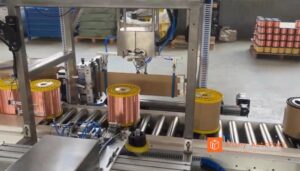
An automatic battery labeling machine generally combines product handling, detection, positioning, label dispensing, application, and optional inspection.
1. Battery Feeding
The battery enters the machine through a conveyor or automatic feeding system.
2. Product Detection
A photoelectric sensor detects the incoming battery.
3. Product Positioning
Guides, belts, pneumatic cylinders, or customized fixtures position the battery.
4. Label Dispensing
The labeling head separates the label from its backing liner and feeds it toward the application point.
5. Label Application
The label is applied using a roller, pressing pad, brush, vacuum applicator, or wrap-around mechanism.
6. Label Pressing
A pressing mechanism improves contact between the label and battery surface.
7. Inspection
Optional sensors or vision systems verify label presence, position, orientation, or printed information.
Typical process:
Battery Feeding → Detection → Positioning → Label Dispensing → Label Application → Pressing → Inspection → Discharge
Battery Labeling Machine With Barcode and QR Code Inspection
For battery manufacturing applications requiring product traceability, the labeling system can be combined with variable-data printing and machine vision.
A typical system can perform:
Printing → Labeling → Code Reading → Position Inspection → Product Verification
The vision system can check whether a barcode or QR code is present and readable. Depending on the production requirements, the system can also verify label position and orientation.
This allows the labeling machine to become part of a broader product identification and traceability process.
Battery Traceability and Battery Passport
Battery traceability is becoming increasingly important as manufacturers and regulators seek greater visibility into battery identity, composition, performance, and lifecycle information.
A battery passport is a digital information concept associated with an individual battery or battery product. It can connect the physical battery with information related to areas such as identity, materials, performance, and lifecycle.
For a labeling machine, this creates an interesting connection between the physical product and its digital identity: a barcode, QR code, or other machine-readable identifier can provide the link between the battery and its digital information system.
Source: Wikipedia, Battery passport — Wikipedia – Battery passport
Mobile Battery Labeling Machine

A mobile battery labeling machine generally refers to a compact labeling system that can be moved between production areas.
This configuration can be useful for manufacturers that produce multiple battery models, operate several production lines, or have limited factory space.
A mobile machine may be equipped with casters and a compact frame. However, it should normally be positioned securely before automatic labeling begins to maintain consistent product positioning and labeling accuracy.
Battery Labeling Machine Factory
When searching for a battery labeling machine factory, buyers should evaluate more than the machine’s advertised speed.
Important factors include:
Product testing capability
Machine customization
Labeling accuracy
生产速度
Electrical configuration
Control system
Vision inspection
Spare-parts availability
Installation support
Operator training
After-sales technical support
A professional manufacturer should be able to test the customer’s actual battery and label samples before finalizing the machine configuration.
How to Choose a Battery Labeling Machine
The most important principle is to select the machine according to the actual product and labeling application, rather than simply choosing a machine based on the word “battery.”
| Battery / Application | Possible Labeling Method |
|---|---|
| Cylindrical battery | Wrap-around labeling |
| Flat battery | Top or front labeling |
| Prismatic battery | Side or front labeling |
| Battery pack | Flat-surface labeling |
| Large storage battery | Heavy-duty conveyor labeling |
| Multiple labels | Multi-head labeling |
| Traceability application | Labeling + printing + vision inspection |
Before requesting a quotation, provide the machine manufacturer with:
Battery dimensions
Battery weight
Battery photos or samples
标签尺寸
Label material
标签位置
Required production speed
Number of battery models
Barcode or QR-code requirements
Production-line requirements
References
Source: Wikipedia, Electric battery — General information about batteries, primary and secondary batteries, battery applications, and different battery sizes and configurations. Wikipedia – Electric battery
Source: Wikipedia, Battery nomenclature — Information about battery naming systems, cylindrical/round and prismatic battery shapes, and battery form factors. Wikipedia – Battery nomenclature
Source: Wikipedia, Lithium-ion battery — Technical background on lithium-ion battery construction, electrochemistry, electrodes, electrolytes, and common lithium-ion battery technologies. Wikipedia – Lithium-ion battery
Source: Wikipedia, Label — General information about product labels, labeling materials, printed information, product identification, safety information, and labeling applications. Wikipedia – Label
Source: Wikipedia, Pressure-sensitive adhesive — Background information about pressure-sensitive adhesives used for labels, including adhesion, surface conditions, temperature effects, and bonding characteristics. Wikipedia – Pressure-sensitive adhesive
Source: Wikipedia, Battery passport — Background information about battery passports, digital battery identity, traceability, material information, performance data, and battery lifecycle information. Wikipedia – Battery passport
Source: Wikipedia, List of battery sizes — Information about common battery sizes, shapes, characteristics, and battery designation systems. Wikipedia – List of battery sizes